
For millions of Southern California drivers, navigating the I-405, I-5, or Pacific Coast Highway is a physical endurance sport. Hours spent idling in gridlock force the human body into prolonged, asymmetrical positions that modern anatomy was never designed to endure.
Beyond general stiffness, repetitive pedal work and chronic traffic stress create specific neuromuscular strain patterns. Understanding the mechanics of “commuter spine” is the first step toward releasing pain, restoring mobility, and driving comfortably.
The Biomechanics of Pedal Fatigue: Why Your Right Side Hurts
Driving creates an inherent asymmetrical load on the lower body. Your right leg is constantly active while your left leg remains idle, so your pelvis, hips, and lower back experience continuous torsional imbalance.
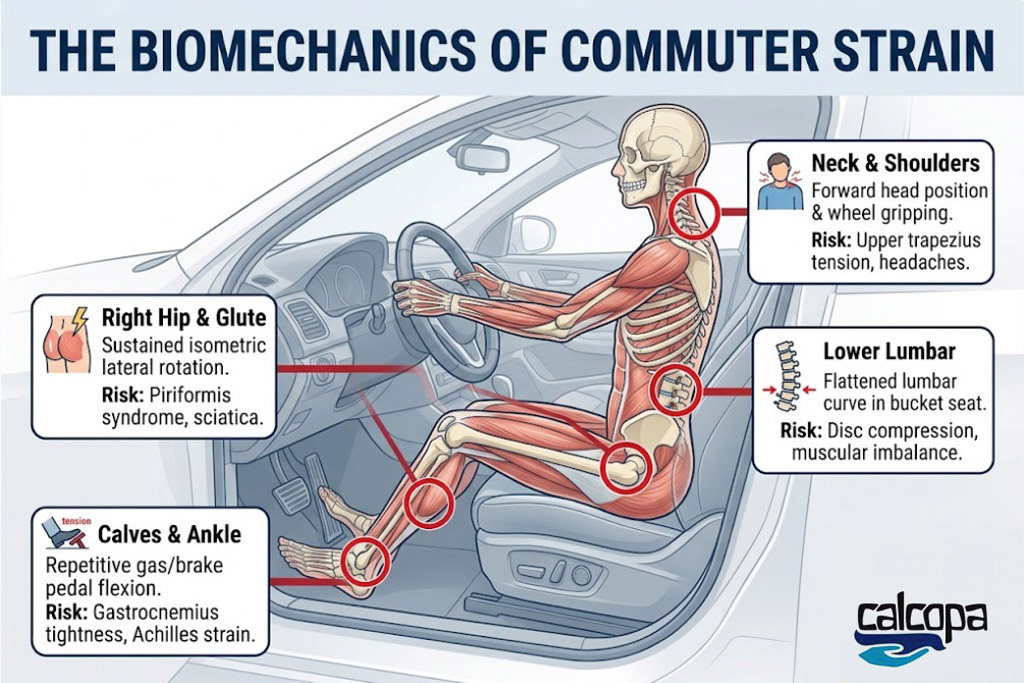
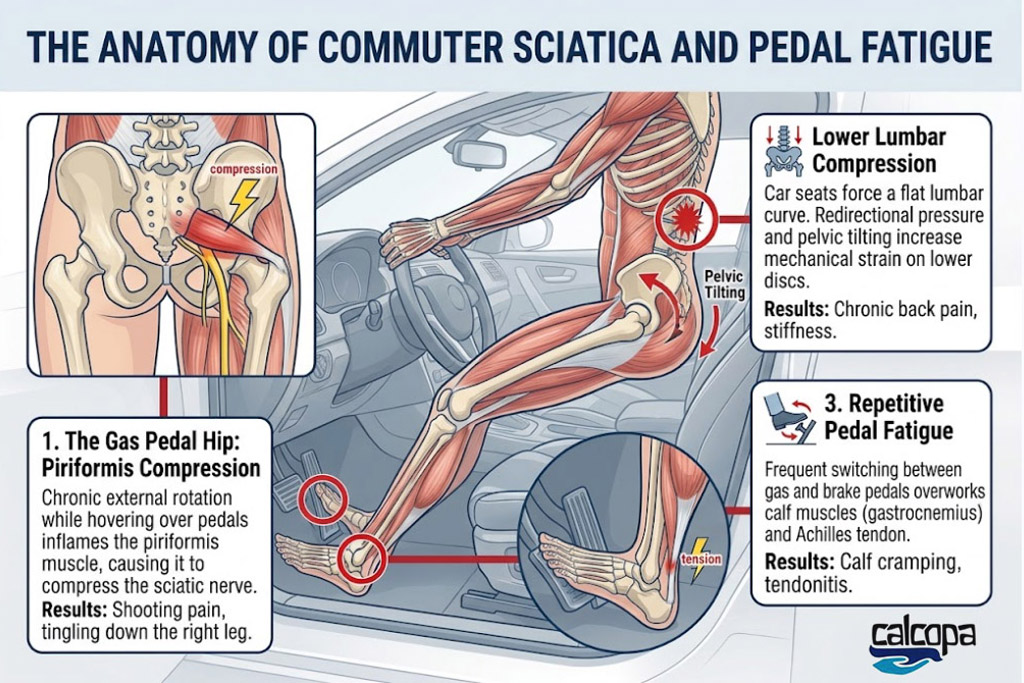
The Gas Pedal Hip (Piriformis & TFL): Hovering over and depressing the gas pedal forces the right foot into sustained plantar flexion and slight external rotation. This locks the tensor fasciae latae (TFL), iliopsoas, and piriformis into chronic contraction. Over time, an inflamed piriformis compresses the underlying sciatic nerve, sending shooting pain down the right leg.
Brake Pedal Compression: Abrupt braking and steady pressure require eccentric force from the quadriceps and hamstrings. This pulls on the ischial tuberosity (sit bones) and causes pelvic tilting, exacerbating lower lumbar strain.
“Wallet Sciatica”: Keeping a wallet or phone in your back pocket while driving tilts the pelvis sideways, unbalancing the lumbar vertebrae and placing direct mechanical pressure on the sciatic nerve.
The Stress Connection: How Traffic Anxiety Shapes Your Posture
It isn’t just posture that causes driving pain; neurochemistry plays a massive role. Unexpected traffic jams, aggressive drivers, and strict schedules trigger the body’s sympathetic nervous system (“fight-or-flight” response).
Elevated Shoulders: Anxiety releases cortisol and adrenaline, causing the upper trapezius and levator scapulae muscles to contract. Drivers unconsciously elevate their shoulders toward their ears.
Steering Wheel Grip Strain: Tighter hand grip on the wheel creates isometric strain through the forearm flexors, radiating upward into the biceps, shoulders, and suboccipital muscles at the base of the skull, leading to cervical headaches.
Shallow Breathing: Stress induces shallow chest breathing, overworking the scalene and sternocleidomastoid (SCM) neck muscles and pulling the cervical spine into a forward-head slump.
How Clinical Massage Therapy Restores the Driver’s Body
Standard stretching rarely resolves deep commuter strain because long hours behind the wheel create micro-adhesions in the muscular fascia and active myofascial trigger points. Targeted clinical bodywork addresses these root causes directly:
Trigger Point Deactivation: By applying sustained, targeted pressure to hyper-irritable knots in the piriformis, gluteus medius, and calf muscles, therapists interrupt the pain-spasm cycle and restore normal nerve conduction.
Myofascial Release: Structural bodywork stretches the dense web of connective fascia surrounding the hip flexors and lumbar region, undoing the persistent slump forced by car bucket seats.
Parasympathetic Reset: Focused manipulation lowers systemic cortisol, shifting the nervous system out of “traffic survival mode” into rest and repair, which relaxes tight muscles body-wide.

Relief and Opportunity at CalCopa Massage School in Huntington Beach
Whether you are seeking relief from your daily commute or looking to build a career treating these ubiquitous pain patterns, CalCopa Massage School in Huntington Beach serves as a premier local center for bodywork education and wellness.
1. Experience Affordable Care at the CalCopa Student Clinic
Orange County commuters don’t need to pay premium resort prices to receive effective bodywork. The CalCopa Student Clinic provides accessible, high-quality clinical massage therapy to the local community.
-
Targeted Relief: Student practitioners under expert clinical supervision deliver focused bodywork tailored to driver fatigue, sciatica, and chronic neck strain.
-
Accessible Wellness: Frequent driving care becomes realistic with affordable student massage rates right in Huntington Beach.
2. Master Orthopedic Bodywork in a High-Demand Healthcare Career
With millions of drivers experiencing chronic back and hip pain across California, skilled clinical massage therapists are more essential than ever.
-
Clinical Anatomy Training: At CalCopa, students don’t just learn basic relaxation routines; they study functional anatomy, postural analysis, and trigger point therapy to treat real-world conditions like commuter strain.
-
Flexible Career Paths: Gain hands-on hours in small class environments that prepare you to collaborate with chiropractors, physical therapists, or launch your own clinical practice in Southern California in as little as six months.
Frequently Asked Questions
Why does driving cause pain specifically in the right hip and leg?
Driving requires constant right-leg activation to shift between the gas and brake pedals. This keeps the hip in continuous isometric rotation and contraction. This asymmetrical effort strains the piriformis muscle, hip flexors, and sciatic nerve while the left leg remains passive.
How can I reduce back pain while driving in Orange County traffic?
Adjust your seat so your knees are level with or slightly lower than your hips. Remove wallets or items from back pockets. Utilize lumbar support rolls. Hold the steering wheel at 9 and 3 o’clock with relaxed shoulders.
How does a student massage at CalCopa differ from a spa massage?
CalCopa’s Student Clinic focuses on clinical, results-oriented bodywork. Under the guidance of experienced instructors, student therapists apply structural techniques, trigger point therapy, and clinical anatomy knowledge to relieve specific issues like lower back pain and tight hip rotators.
Ready to relieve commuter pain or start a career in clinical bodywork?
Book an Affordable Massage at the CalCopa Student Clinic or Explore Our 2026 Class Schedule at our Huntington Beach campus today!