
Whether working in an office setting or managing a remote workstation from a home office, millions of professionals spend upwards of eight to ten hours a day seated in front of a computer screen. Prolonged desk work subjects the human spine and surrounding musculature to static loads that modern human anatomy was never designed to endure.
Beyond general stiffness, sitting in a office chair creates specific postural strain patterns. Just as we explored how driving forces asymmetrical strain on the body in our guide on Commuter Spine, sitting statically at a desk creates its own unique mechanical stress on the spine. Understanding the biomechanics of “desk spine” is the critical first step toward releasing pain, improving posture, and restoring daily movement.
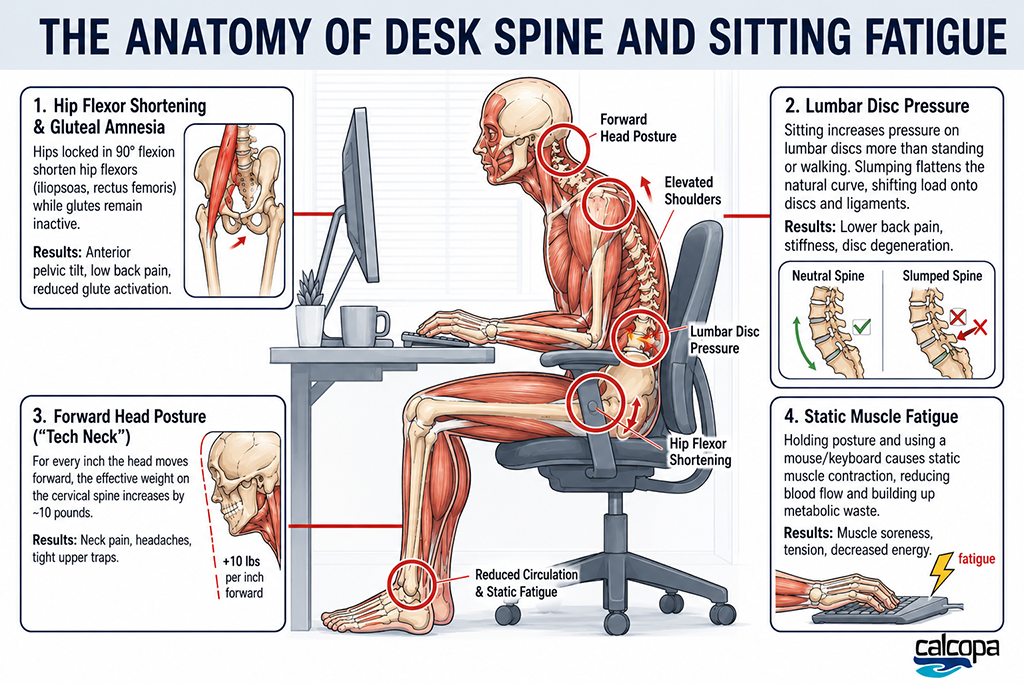
The Biomechanics of Sitting: What Happens to the Body at a Computer
When you sit at a desk—especially for extended, uninterrupted stretches—the natural curves of your spine undergo significant mechanical distortion.
-
Hip Flexor Shortening & Gluteal Amnesia: In a seated position, your hips remain locked in 90-degree flexion. Over time, the primary hip flexors (the iliopsoas and rectus femoris) chronically shorten and tighten. Concurrently, the gluteal muscles remain fully extended and inactive—a phenomenon often referred to as “gluteal amnesia.” When you finally stand up, tight hip flexors pull the pelvis forward, placing excessive arc and sheer stress on the lower lumbar spine.
-
Lumbar Disc Pressure: Sitting actually places higher intradiscal pressure on the lumbar spine than standing or walking. Slumping or hunching forward over a keyboard removes the natural inward curve (lordosis) of the lower back, shifting weight bearing from the bony structures directly onto the intervertebral discs and spinal ligaments.
-
Forward Head Posture (“Tech Neck”): For every inch the head shifts forward past neutral alignment to view a monitor, the effective weight of the head on the cervical spine increases by approximately 10 pounds. This forces the upper trapezius, levator scapulae, and suboccipital muscles at the base of the skull into continuous, exhausting isometric contraction.
Stress and the Desk Environment: Subconscious Muscle Tension
Much like the physical impact of traffic stress, the mental demands of the workplace actively shape your physical posture:
-
Static Muscle Fatigue: Unlike dynamic movement where muscles contract and relax, holding a mouse or staring at a screen requires static muscular contraction. This reduces local blood circulation, leading to a accumulation of metabolic waste products and persistent muscular aches.
-
Breathing Mechanics: Hunching over a computer restricts the diaphragm’s ability to expand downward into the abdomen. Desk workers frequently default to shallow chest breathing, overworking the scalenes and neck muscles to pull air into the upper lungs.
-
Elevated Shoulders: Stressful deadlines, heavy email volumes, and intense concentration trigger a subconscious elevation of the shoulder girdle toward the ears, creating dense myofascial trigger points throughout the neck and mid-back.
How Massage Therapy Restores the Desk Worker’s Body
Stretching at your desk provides temporary relief, but deep structural tightness and persistent postural habits often require targeted clinical intervention:
-
Myofascial Release for the Anterior Chain: Bodywork focuses on opening up the front of the body—releasing tight pectoral muscles, hip flexors, and anterior neck structures—allowing the spine to naturally return to an upright position without forced muscular strain.
-
Trigger Point Therapy for Referred Pain: By addressing hyper-irritable trigger points in the upper trapezius, rhomboids, and lumbar extensors, massage therapists can deactivate referred pain patterns that cause tension headaches and lower back ache.
-
Restoring Tissue Mobility: Deep tissue manipulation helps break up micro-adhesions in fascia that form when muscles are kept in static positions for hours on end, restoring blood flow and range of motion.
Experience Care at the Calcopa Student Clinic in Huntington Beach
Whether you are looking to address back pain from desk work or seeking a career helping others manage chronic pain, Calcopa Massage School in Huntington Beach serves as a local center for wellness and education.
1. Receive Affordable Care at Our Student Clinic
You don’t need to live with daily desk fatigue. The Calcopa Student Clinic provides accessible, high-quality bodywork to the local community.
-
Targeted Relief: Student practitioners under expert clinical supervision deliver focused bodywork tailored to postural strain, lower back tightness, and neck tension.
-
Accessible Community Wellness: Regular, therapeutic care becomes realistic with affordable student massage rates.
2. Learn Orthopedic Bodywork in a High-Demand Field
With millions of individuals working desk jobs across Southern California, skilled clinical massage therapists are increasingly essential.
-
Practical Anatomy Training: At Calcopa, students study functional anatomy, postural assessment, and targeted modalities to address real-world conditions like desk spine and postural dysfunction.
-
Flexible Career Paths: Prepare to practice in wellness centers, launch an independent practice, or collaborate within broader healthcare environments through small, hands-on classes.
Frequently Asked Questions
Why does my lower back hurt after sitting at a desk all day? Sitting flattens the natural lumbar curve of your spine, increasing pressure on the intervertebral discs. Additionally, prolonged sitting shortens your hip flexors, which pulls on your lower back and pelvis when you stand, causing persistent lumbar tightness.
How often should a desk worker get a massage? For acute postural pain, weekly or bi-weekly clinical bodywork sessions can help reset muscle tone and release dense trigger points. For long-term maintenance, monthly sessions combined with regular movement breaks at work are highly effective.
What simple changes can I make at my desk right now? Position your monitor so the top third of the screen is at eye level, keep your feet flat on the floor, take a short standing or walking break every 30 to 45 minutes, and avoid slumping forward toward your screen.
Book an Affordable Massage at the CalCopa Student Clinic or Explore Our 2026 Class Schedule at our Huntington Beach campus today!